
Parenting & Learning
Dr. Manjit Legha
Cracks That Shine: The Kintsugi Lesson for Children and Parents
- Dr. Manjit Legha
- July 31, 2026
Cracks That Shine: The Kintsugi Lesson for Children and Parents
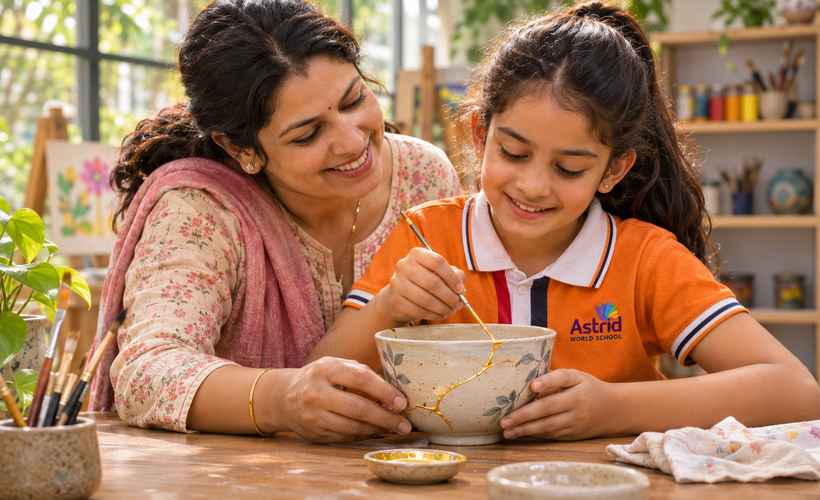
In Japan, there is a beautiful art called Kintsugi, repairing broken pottery with gold. Instead of hiding the cracks, they are filled and celebrated, turning the object into something more precious than before.
In today’s fast‑paced, tech‑driven world, as parents and caregivers, we are constantly nudged towards speed and perfection. But children don’t grow in straight lines, do they?.
They stumble, spill, forget, and try again. Their learning is literally work in action.
At Astrid, we believe it’s okay for children to have cracks – moments of failure, frustration, or imperfection. What matters most is teaching them how to mend those cracks with courage, creativity, and kindness. When a child learns to fix a mistake, reflect, and move forward, they discover resilience.
Parents often worry: “What if my child fails?” But it is critical to remember that failure is not the end; it’s the gold that makes the vessel stronger. By embracing mistakes, reflecting upon missed steps, fixing up the gaps and modeling perseverance, we show children that cracks are not flaws to fear, but opportunities to shine.
Here are some simple Strategies that we can follow as Parents & caregivers.
Mending Cracks with Gold:
1. Celebrate Effort, Not Just the Outcome
- Praise the attempt (“I love how you kept trying”) rather than only the result.
- This teaches children that persistence is equally valuable, even if the puzzle isn’t solved yet.
2. Create a “Mistake Journal”
- Encourage children to jot down or draw one mistake each week and what they learned from it.
- Over time, the journal becomes a treasure chest of growth.
3. Model Your Own Cracks
- Share small personal failures (maybe a burnt dinner, or a forgotten password) and how you fixed them.
- Children learn that adults too mend and move on.
4. Introduce Playful Repair Rituals
- Break a clay pot together and glue it back with paint or glitter.
- Use it as a metaphor: “See, it can be beautiful all over again.”
5. Practice “Pause & Reflect” Moments
- When frustration rises, teach children to pause, breathe, and ask: “What can I try differently?”
- Such habits build emotional regulation and problem‑solving.
By weaving these strategies into everyday life, we can help children see that cracks are not the end of the story — they are the beginning of strength.
At Astrid, we want every child to carry such cracks as golden stories of resilience, creativity, and courage.